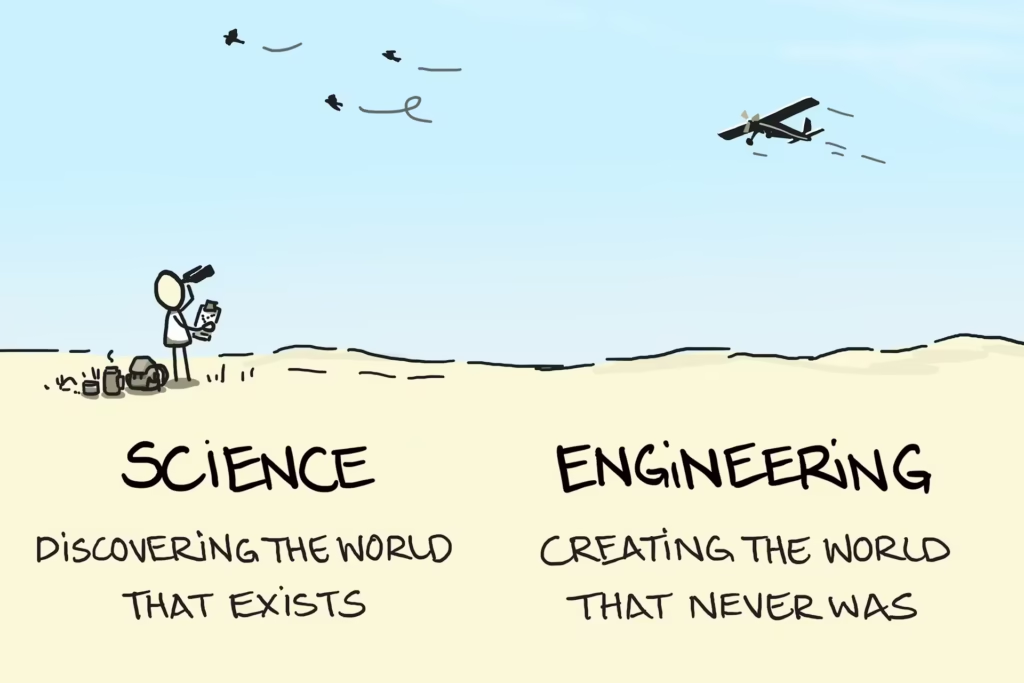
Have you ever wondered what is the difference between an engineer and a scientist? Since I happen to be both in a single person, I should be able to tell you. Yet, for me the borderline, especially in quantum computing, is not always clear.
1. Time-frame and Money
Scientists COST the company money.
Engineers MAKE the company money. [1]
I found this Reddit statement a good starting point. It mostly refers to the timescale at which both of them operate. While scientists have the freedom to explore and investigate phenomena, the work of engineers is more focused on delivering results within a specific time-frame.
This is directly reflected in the way it produces value for the company and society. While basic research can contribute up to 50% of return on investment for society, the typical time-frame for that is 20 years [2]. The opposite is true for engineering, which often brings more immediate returns to a much narrower group of people, often a specific company (10% of ROI), but in the much shorter time-frame of 1-5 years. In a nutshell, since science benefits society in the long term, it is often funded by public money, while engineering is more directly connected to the market and private funding.
2. The Goal
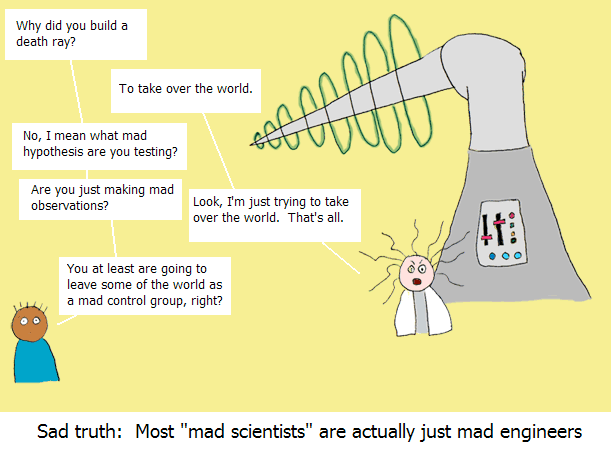
A scientist builds stuff to figure s*** out.
An engineer figures s*** out to build stuff. [1]
Following up on another Reddit wisdom [1], another difference between scientists and engineers is their mindset. Scientists are stereotypically focused on understanding phenomena, discovering new effects, and pushing the boundaries of knowledge.
Yet knowledge is not a product (see above), and it is not easy to sell. Engineers, on the other hand, are focused on solving problems, building things, and creating value. In a paper from 1967 [3], besides a long tirade about how to fascinate kids with engineering, I found that engineers are producers of capital goods—the whatchamacallits that can repeatedly be used to produce other goods and services.
3. The Philosophy

What is in the box?
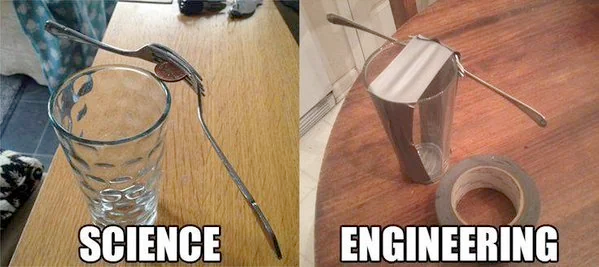
The difference in mindset can be summarized by the approach of both groups to the “black box.” While the engineer would be more interested in characterizing the input-output behavior of the box, the scientist would be more interested in understanding the internal workings of the box.
This creates a natural distinction and tension between them. While scientists are slowing down the process by trying to understand the box, engineers are more focused on connecting the box to other boxes and making it work in a system.
[1] https://www.reddit.com/r/AskEngineers/s/ZOxihDaVCk
[2] Jones, B. F., & Summers, L. H. (2020). “A Calculation of the Social Returns to Innovation”.
[3] R. Hoyle, “Engineers and scientists – understanding the differences,” in Electronics and Power, vol. 13, no. 2, pp. 49-51, February 1967, doi: 10.1049/ep.1967.0036.
Other sources:
[4] Ramsden, Jeremy. “The differences between engineering and science.” Measurement and Control 45.5 (2012): 145-146.
[5] https://www.bu.edu/eng/about-eng/meet-the-dean/engineering-is-not-science/
Coming next in Part 2:
We have the Scientist stuck inside the box, and the Engineer stuck outside of it. But is there a third way to look at the problem? In the next post, we will explore the common ground where these two worlds merge.
More memes:


Leave a Reply